
 English
 Հայերեն

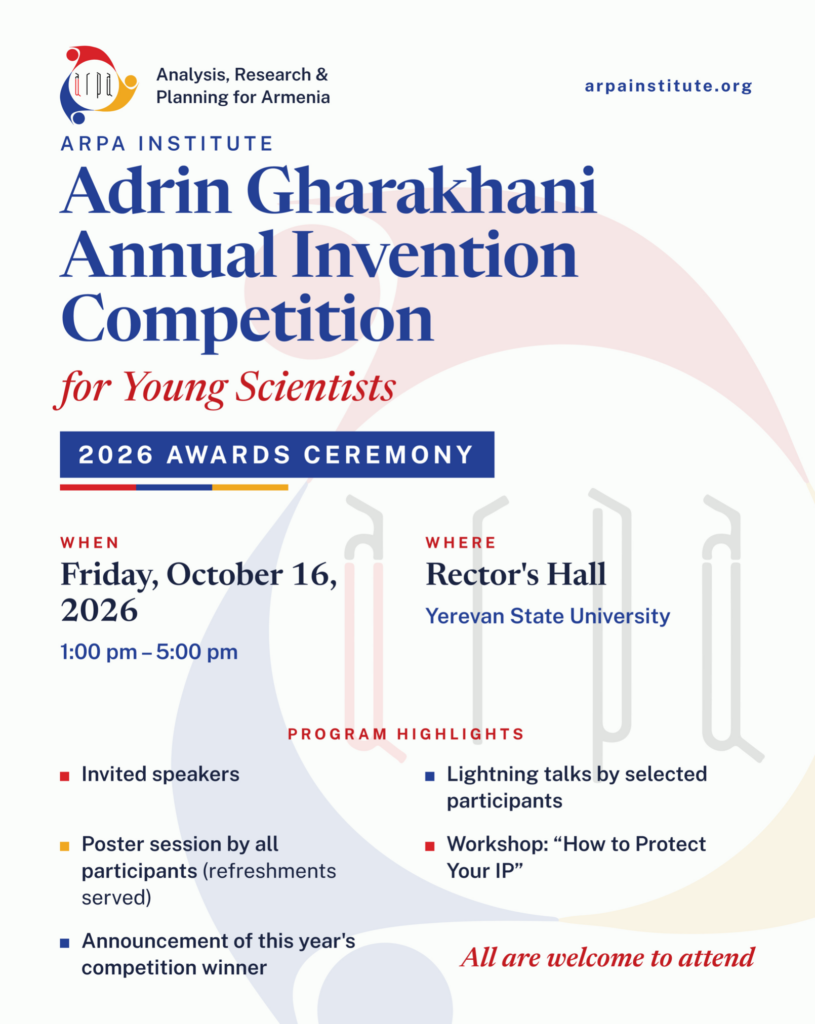
ARPA Institute Adrin Gharakhani Annual Invention Competition
Guidelines for the ARPA Institute Adrin Gharakhani Annual
Invention Competition for Young Scientists in Armenia
Please read the following information carefully and in its entirety. Applications
deviating from these specific guidelines and requirements (including format
guidelines and personal information) will be disqualified. The deadline for
submitting applications is May 30. Please send applications to the following email
address:
arpainstitute@gmail.com
Organizer: ARPA Institute of Los Angeles, California, USA.
Sponsors: The ARPA Institute and the Ministry of Education, Science, Culture, and
Sports of Armenia.
Objectives: ARPA Institute Adrin Gharakhani Annual Invention Competition for Young
Scientists is a contest designed to encourage young scientists active in science,
engineering, mathematics, technology, and creative invention, while stimulating their
problem-solving abilities. This prestigious challenge also recognizes the productive
relationship among a team of researchers and their mentors that is essential to
economic growth and leadership.
The amount of the prize is $10,000. There will only be one prize. Applicants will be
required to submit progress reports of their ongoing work on the invention at the 6- and
9- month after receiving the prize for at least the first year. Progress reports should
consist of a minimum of two pages highlighting improvements to the innovation or new
experiments/data. Even if the data is not promising, or experiments have failed, the
committee would still like to see this data. If the progress reports are satisfactory and
substantial progress is seen, ARPA Institute may continue to fund the project.
Requirements for Application Submission:
Eligibility Requirements: All young scientists of Armenia who are no more than 35
years of age, or any graduate students who are enrolled, or have been enrolled, full
time in any recognized university in Armenia, at least part of the 12-month period prior
to the date the entry is submitted. In the case of a team, all scientists and/or students in
the team must satisfy requirements and, submit the required forms filled out and signed
for fulltime student by the required signatories.
Format requirements: English Language, Arial font, 11-point font, 0.5” inch
margins, 15-page limit, 1 additional page for figures or graphs, Page numbers on
every page, Single Space, Submission in PDF format.
General Requirements: The invention, a reduced-to-practice idea or workable model,
must be the work of a scientist or team of maximum 4 scientists, or a team with their
university advisor. If it is a machine, it must be operable. If it is a chemical, it must be
complete with evidence of successful application of the idea. If it is a recently
discovered plant, color photographs or slides must be included in the submission. If a
new or original ornamental design for an article of manufacture is submitted, the entire
design must be included in the application (exceptions will be made if more pages are
necessary to include the entire design). In addition, the invention should be reproducible
and should have potential in becoming a commercial product. The entry must be the
original idea and work product of the young scientist(s) or scientist/advisor team and
may not have been (1) made available to the public as a commercial product or process
or (2) been patented or published more than 1 year prior to the date of submission to
the competition.
Text Requirements: Introduction – Describe your invention in a brief but complete
manner. Include an analysis and comparison of your invention with similar existing
works/patents. State the advantages of your invention over existing similar works in the
international literature. Clearly and concisely explain the value of the invention, and its
significance and potential contribution to the world. Give a brief description of the
invention: What is it? What does it do? How does it work? How can it become a
commercial product?
Data – Describe the invention characteristics with data from actual experimentation or at
least simulated experimentation. In the additional page, include pictures of the
invention/innovation (if applicable) or graphs showing experimental results and their
significance. Conclusions – Write your final remarks that summarize the important
characteristics of your innovation and how your data supports that notion. Clearly
highlight the improvements your innovation makes on current technologies/systems and
what potential areas of need it can fill.
Submission Requirements: Submit the application with title of the invention, the
names and emails of submitting scientists, their affiliations, and phone numbers.
Tips for submitting a competitive application:
Brevity – Be clear and to the point regarding your innovation/invention. It is important to
articulate what the invention is and why the proposed invention has advantages over
existing similar devices. The judges want to know specifically what is different about
your innovation and why it is better than existing systems.
Convincing – It is up to you to convince judges (who could be engineers, scientists,
mathematicians, doctors, environmentalists, physicists, or professors of other fields –
who will be an expert in the field of your application) that your entry is the best of many
high-quality applications. Although the judges are experienced individuals, they may not
be familiar with your project or specialty. Describe your work in the most
comprehensible and understandable manner to a scientifically literate person in a
concise manner.
Completeness – Ensure that your application follows the guidelines and includes all
necessary requirements.
After writing your submission, consider asking a colleague to read your application. It
may help to have someone who is not familiar with your work to review it and see if is
understandable to the non-expert.
All submissions will be reviewed and evaluated by experts and the selection of the
winner will be performed by the ARPA Institute Board of Directors upon the
recommendation of the panel of experts.


